Your lean program delivered real results. Then, organizational pressure scaled, new demands, shifting priorities, market turbulence, and the gains started eroding. The instinct is to optimize harder. Better prioritization. Tighter processes. Another round of waste elimination.
That instinct is wrong. Not because the tools are wrong. Because you are working on the wrong constraint in the wrong sequence.
You have tried to fix it.
Better prioritization. Time-blocking. A tighter system for managing what comes in. Maybe a new approach to delegation. You implemented the changes, held the discipline for a few weeks, and watched the load reassert itself anyway.
The system looked different. But the problem still persisted.
This is not a willpower failure. It is a sequencing failure.
The Constraint Is Not What You Think It Is
On the production floor, you would diagnose this immediately.
A line running at 110% utilization does not need process optimization. It does not need better scheduling or waste reduction or a kaizen event targeting cycle time. It needs the load to be reduced first. Every improvement you make to an overloaded system gets consumed by the overload. The gains disappear. The instability reasserts itself.
You cannot optimize a system that is still overburdened. The sequence matters.
Toyota formalized this logic decades ago. Most practitioners who know lean can name the three terms. Fewer apply them in the right order.
Muri → Mura → Muda
Muri: overburden. The system is being asked to do more than it was designed to handle.
Mura: unevenness. Variation in demand or output that creates instability in the process.
Muda: waste. Non-value-add activity consuming capacity that should be going elsewhere.
The sequence is Muri first. Then Mura. Then Muda. In that order, for a specific reason.

An overloaded system is not just inefficient. It is actively unstable. Improvements made inside an unstable system do not hold. The variation absorbs the gains. Then the waste returns. The leader trying to optimize their way out of overburden keeps finding themselves back at the same constraint… because they are working on Muda while the Muri condition is still running.
Three Practitioners. Same Answer.
I validated this sequence with three independent practitioners: one leading the organization that brought TPS to companies outside Toyota, one a veteran operations executive with decades of manufacturing leadership, and one a TPS practitioner with direct implementation experience across multiple industries.
Same principle. Different words. Same sequence.
You cannot stabilize an overloaded system. Address overburden before anything else. Stability is not the destination. It is the prerequisite.
This convergence matters. It means the sequence is not a framework preference. It is an engineering principle that holds regardless of industry, organization size, or leadership level.
What Muri Looks Like for a Senior Operations Leader
Applied to leadership capacity, Muri is not a feeling. It is a measurable condition.
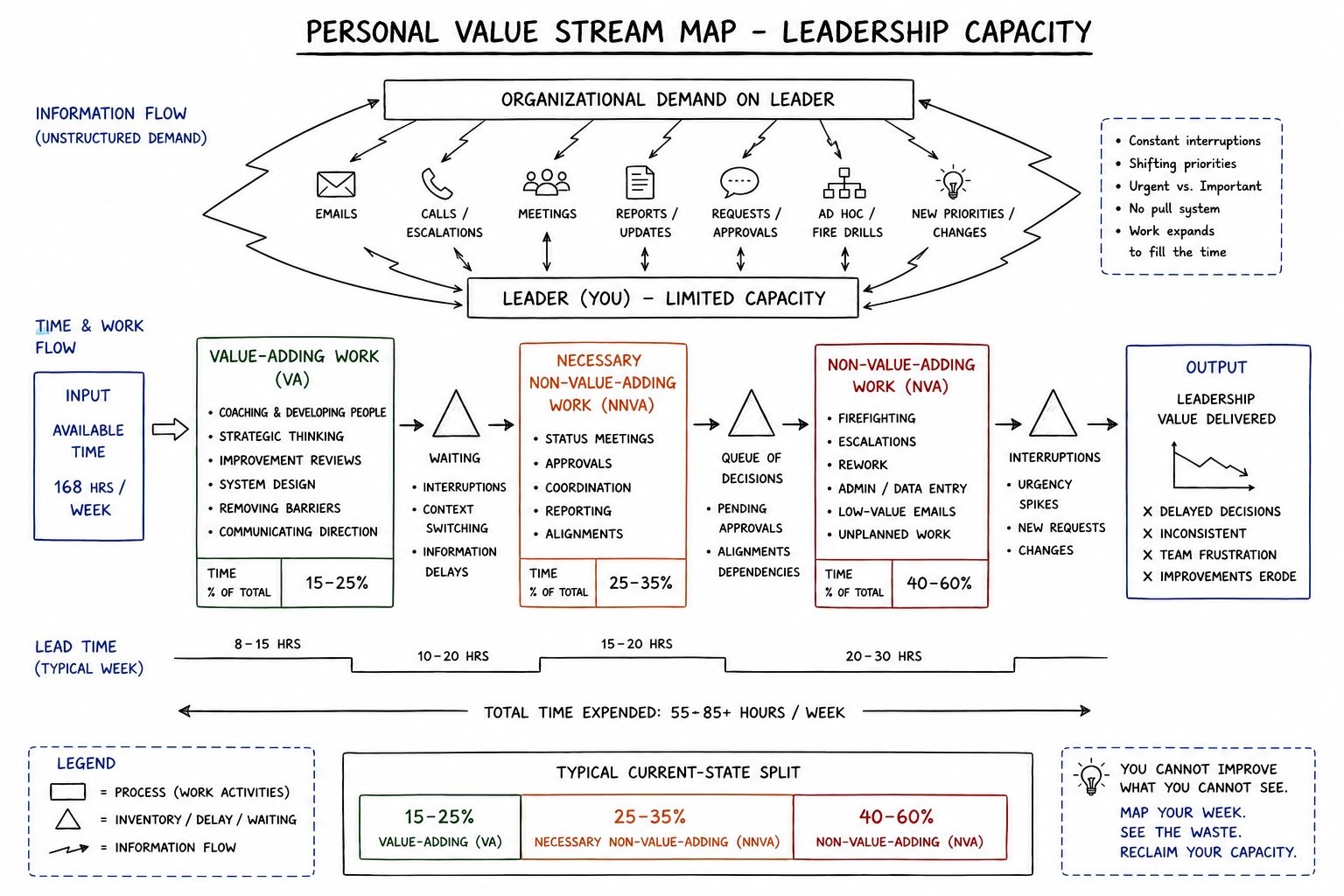
Your system is in Muri when coaching gets crowded out consistently- not cancelled, just perpetually deferred. When strategic thinking requires finding time rather than having it. When your default response to new demands is yes, because the system has no mechanism to say anything else, and there is no buffer to absorb the variation.
The signal is not exhaustion. Exhaustion is a lagging indicator. By the time you feel it the condition has been running for months. The leading indicator is the disappearance of your highest-value work, the same pattern that shows up when any system runs past its designed limits.
That is Muri. And until you address it, nothing else in the sequence will hold.
What Addressing Muri Actually Looks Like
Addressing Muri is not about doing less. It is about removing the overburden before attempting anything else.
In practice, this means two things.
First, make the overburden visible. You cannot reduce what you cannot see. Measuring where your capacity is actually going, before deciding how to recover it, is the starting point.
Second, stabilize before you optimize. The emergency protocols in The Cost of Yes are built for this first response. Stop the bleeding. Bring utilization back to a level the system can sustain. Then improve the system.
You do not redesign the production line while it is running at 110%. You reduce the load first. Then you apply the sequence.
Muri → Mura → Muda. In that order. Every time.
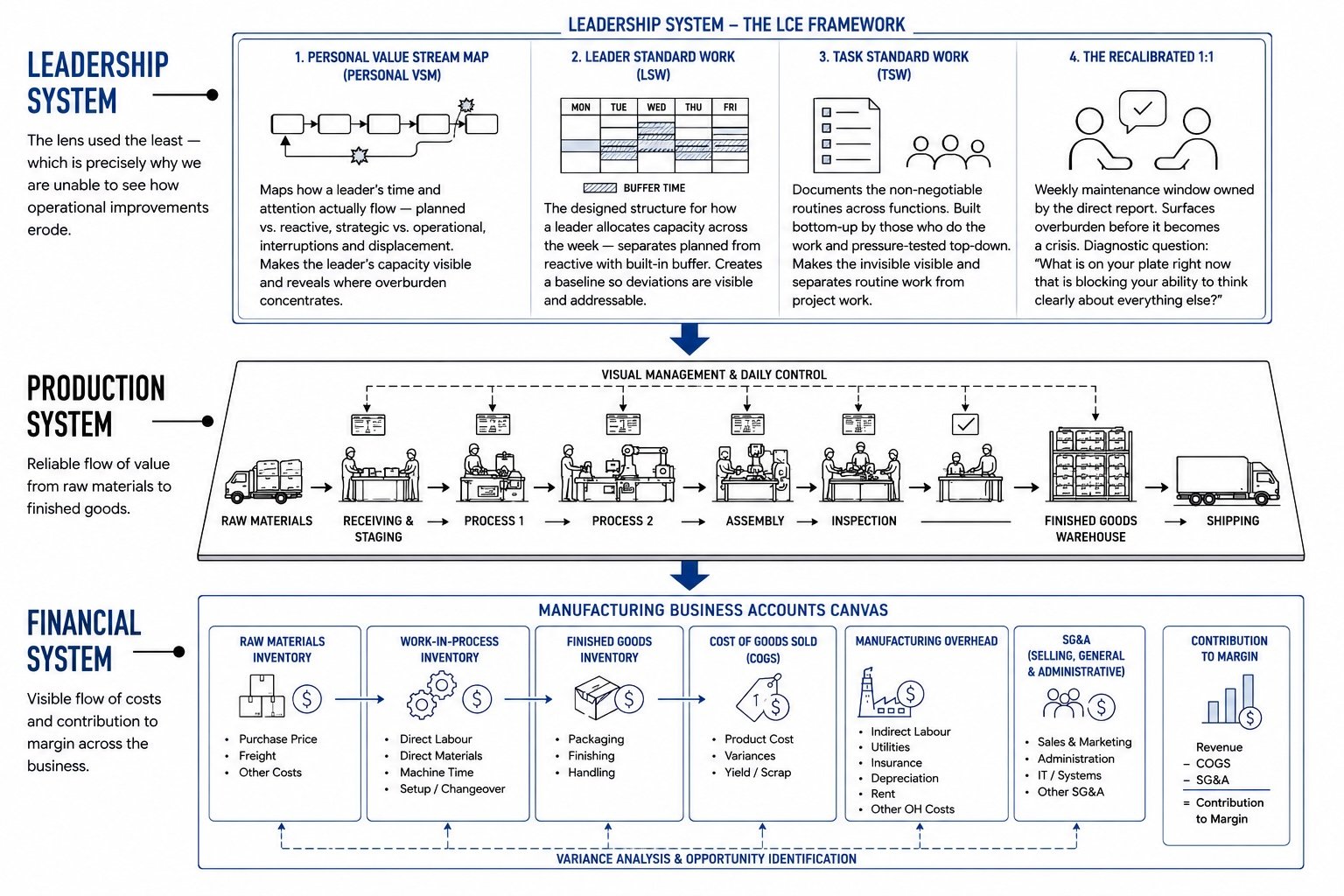
The diagnostic conversation starts with one question: where is the overburden concentrated in your leadership system right now, and what is it displacing? That’s the current state assessment. Everything else follows from seeing it clearly.
Start Here: