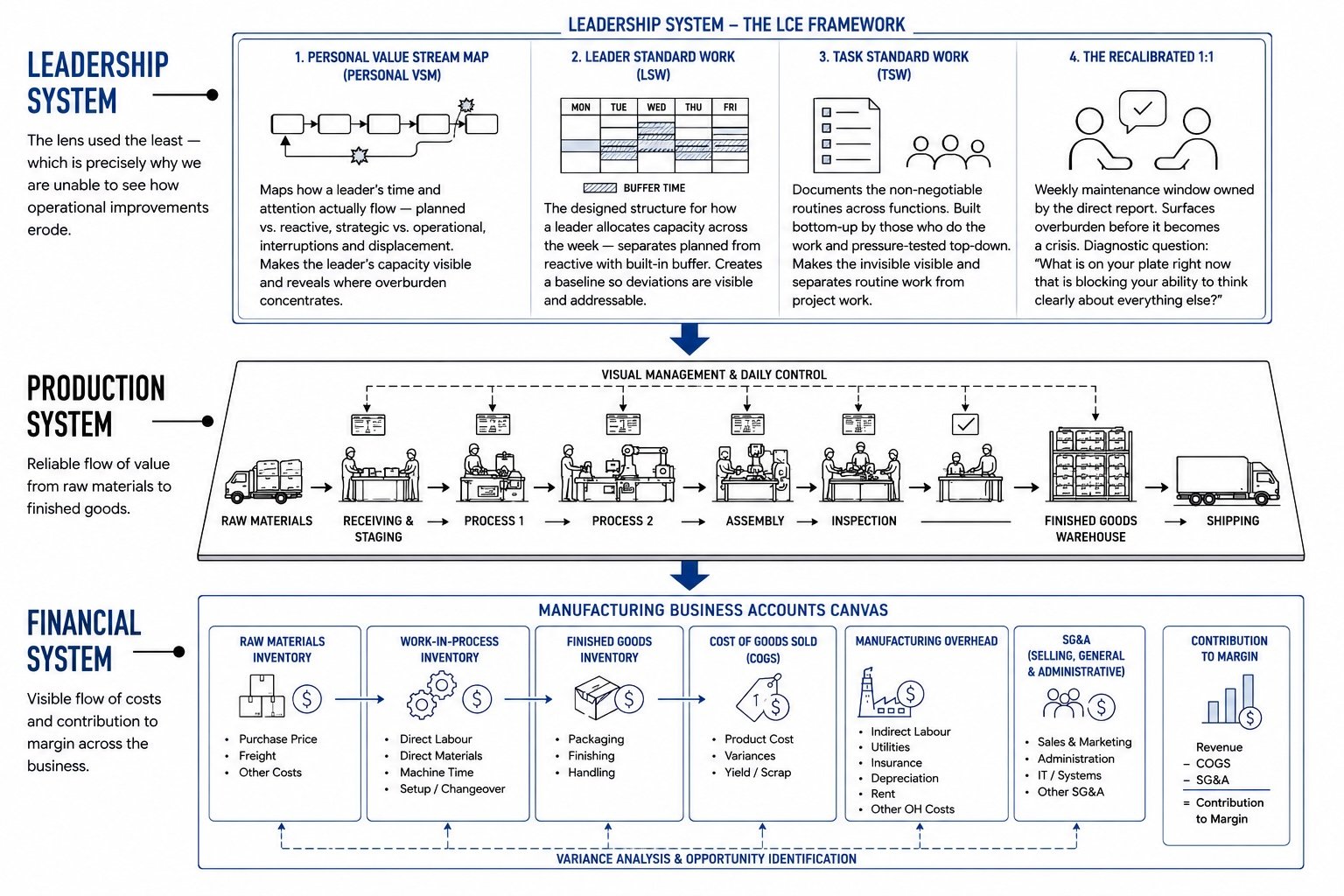
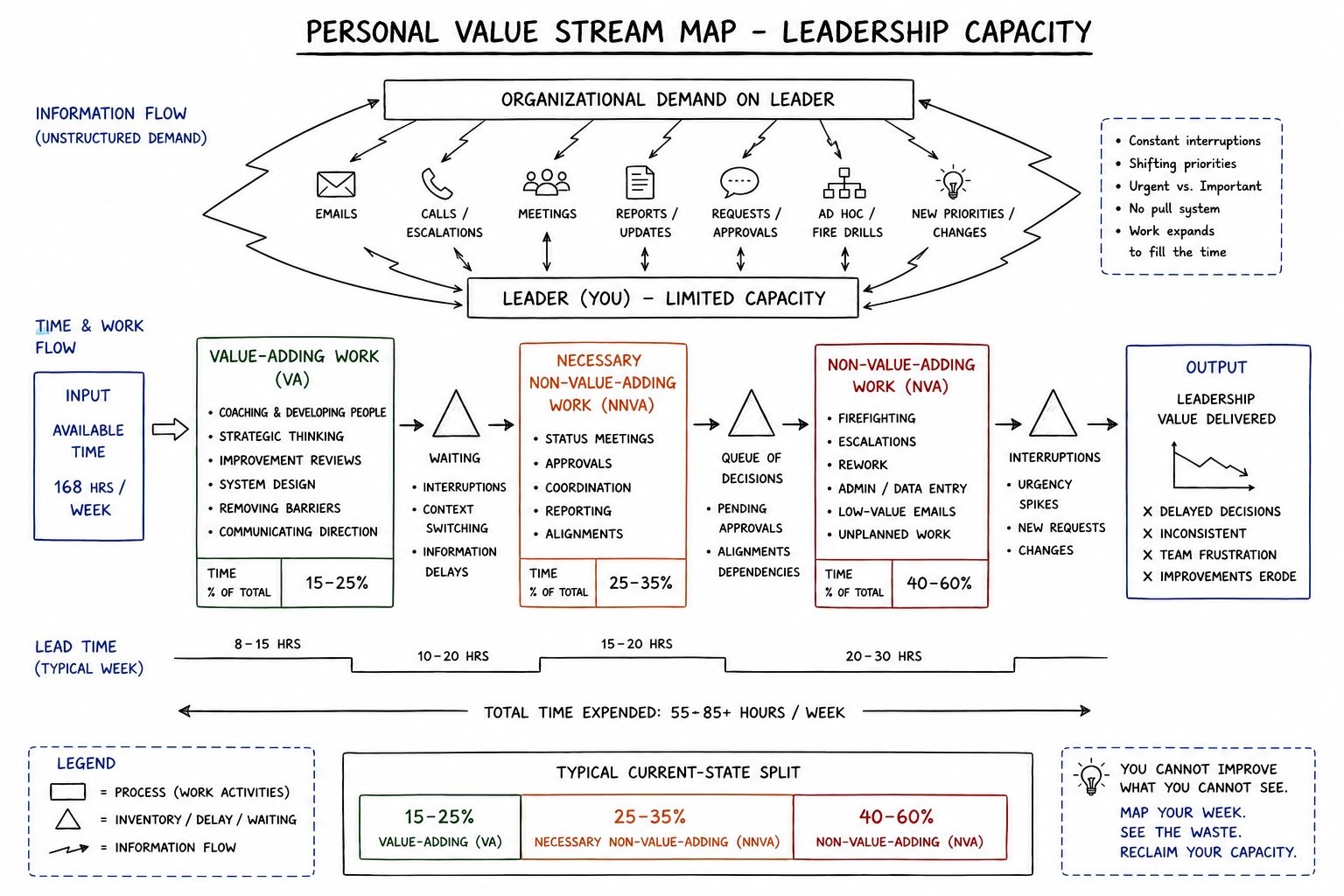
Your lean program has a floor-level problem and a leadership-level problem. The floor-level problem is visible: you can measure it, map it, and improve it. The leadership-level problem is invisible until the gains you worked for start eroding under organizational pressure, and the usual fixes stop working.
You have tried to fix it. Better prioritization. Time-blocking. A tighter system for managing what comes in. The system looked different. But the week was still running you rather than you running it.
This is not a discipline problem. It is a category problem. You were applying a time-management solution to a capacity-engineering problem. Those are not the same thing.
The Difference Between Managing Time and Engineering the System
Time management operates on one assumption: that the problem is how you allocate the hours you already have. So it gives you better tools to prioritize, batch, and protect them.
What it does not do is change the system producing the demand. The requests keep coming. The escalations keep landing. The calendar fills back up within two weeks because nothing upstream changed.
You were trying harder inside a broken system. Trying harder inside a broken system does not fix the system. It just exhausts the person running it.
Standard Work is a different category of intervention entirely.
What Standard Work Actually Does
On the production floor, Standard Work is not a constraint. It is a stability mechanism.
It documents the best-known method for completing a task consistently, at the right quality, within the designed cycle time. It reduces variation. It protects output. And most importantly, it frees up cognitive capacity for problem-solving and improvement rather than recreating the process from scratch every time.
That last part is the one most leaders miss when they hear Standard Work applied to themselves.
Every recurring task you approach without a standard method costs you a decision. How do I structure this? What do I do first? What does good look like here? Each decision is small in isolation. Over a week of recurring tasks without a standard, the cumulative cognitive load is significant.
A leader without Standard Work is making hundreds of small decisions that have already been made on the production floor. The operator does not decide how to run the process each morning. The standard does.
Leader Standard Work: Engineering the Week
Leader Standard Work is not a schedule. A schedule tells you when things happen. Leader Standard Work tells you what the week looks like when you are operating as a leader and protects that picture from being overridden by whoever needs something from you most urgently.
It answers a specific question in advance: what does a week look like when coaching actually happens, when strategic thinking has protected time, when the highest-value activities are not perpetually losing to the loudest demand?
Without it, every week gets designed reactively. The urgent crowds out the important. The fires get put out. The coaching gets deferred. The strategic review gets bumped to next week, then the week after, then the quarter ends and it never happened.
That is not a time management failure. It is the absence of a system designed to prevent it.
With Leader Standard Work, the coaching walk is not squeezed in. It is protected by design. The strategic thinking block is not found; it is a non-negotiable time with a defined purpose. The one-on-ones do not get shortened; they are built into the standard, and the standard holds.
This Is Not Time Management
The productivity system asks you to try harder within the existing structure.
Leader Standard Work changes the structure.
Time management operates on willpower. Standard Work operates on design. When you miss a time block, the productivity system says you need more discipline. When Standard Work breaks down, it asks a different question: what in the system overrode it, and how do we prevent that next week.
That shift, from personal failure to system failure, is the same shift you make on the production floor when a process breaks down. You do not blame the operator. You improve the standard.
You are not managing your time better. You are engineering the system so that time protects itself.
The Compound Effect
Every decision you standardize is a decision you no longer have to make. How you start the day. When you review production data. How you structure a one-on-one. What your weekly close looks like.
Each seems trivial in isolation. Together, they represent a significant portion of the cognitive load accumulating across your week, the same decision fatigue that makes complex problems harder to solve by mid-afternoon, that makes the data feel unreliable, that makes saying yes easier than thinking through the cost.
Standard Work does not just protect your calendar. It recovers cognitive capacity. And that capacity goes somewhere… somewhere higher value than deciding how to start a meeting you run every week.
Leader Standard Work is the starting point. The free LSW template gives you the engineered weekly rhythm built around protecting your highest-value activities first.
Get the Leadership Capacity Engineering News Letter
Biweekly Newsletter with the latest learnings on how lean leaders develop sustainable performance for themselves and their teams. Tools, resources and case studies to help you with your own journey.
Download the Leader's Standard Work Template when you sign up.