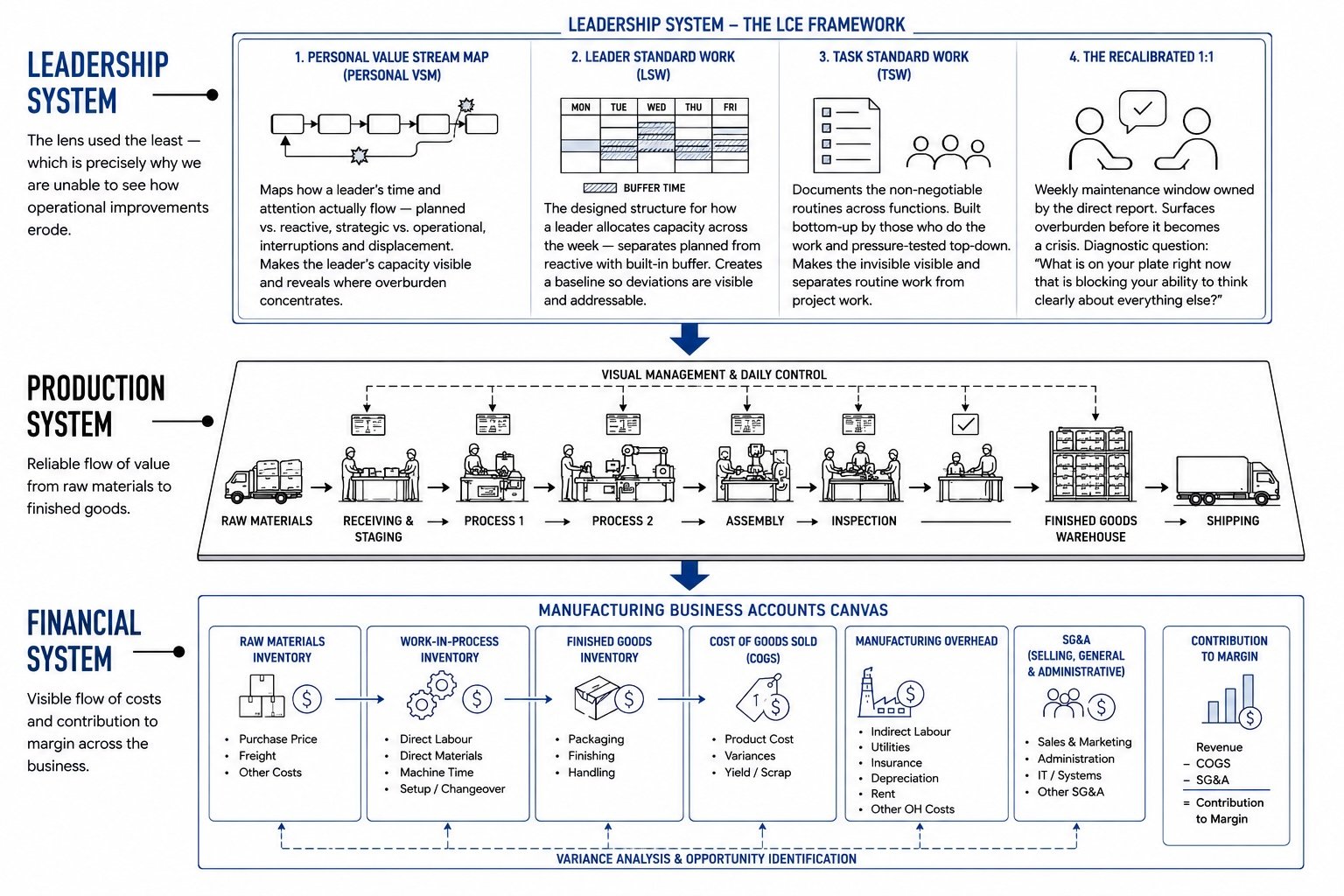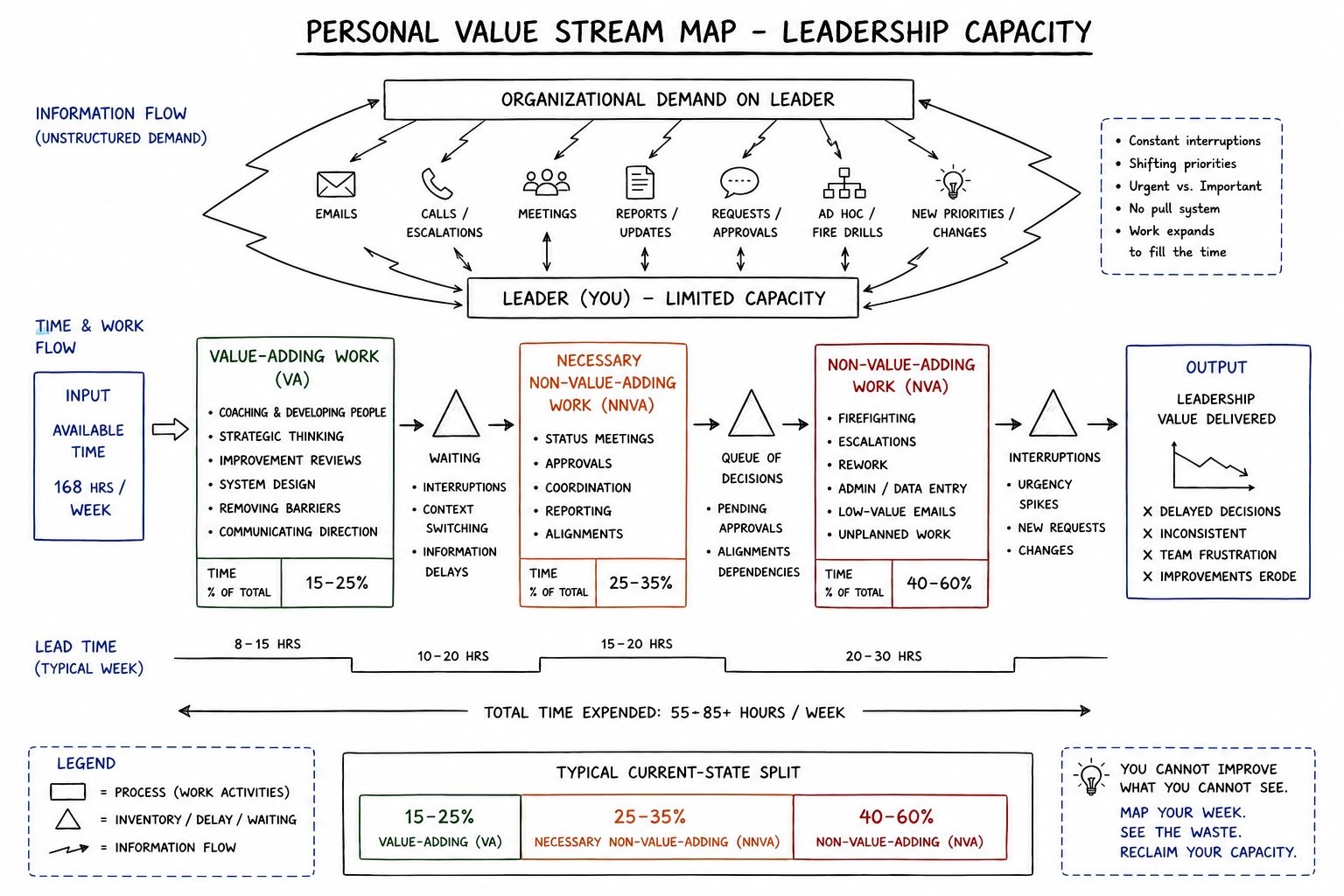
Your lean transformation is producing results on the floor. Then organizational pressure hits. There are new demands, shifting priorities, turbulence, and your best leaders are starting to produce inconsistently. The directions keep changing. The team compensates. Rework increases. Improvement momentum stalls.
The constraint is almost always invisible until it becomes a crisis: overburden in the leadership layer that nobody detected early enough to address.
There is a meeting already on your calendar that could surface that constraint every week before it cascades. You’re almost certainly using it wrong.
The one-on-one.
In most organizations it runs as a status update. The leader sets the agenda. The direct report summarizes progress. A new action item is assigned. Meeting ends. No conversation about whether the person is overloaded, whether their capacity is being consumed by work that shouldn’t be on their plate, or whether something is building that will become a problem before anyone sees it coming.
Used correctly, the 1:1 is the most powerful Muri detection mechanism available to you, and it costs nothing to recalibrate.
The Structure for One-on-One
In validation conversations with three independent TPS practitioners, across lean implementation, manufacturing operations leadership, and direct Toyota methodology, the same structure emerged consistently. This is not a framework preference. It is a validated operational pattern.
At the core of it, there are four questions.
What progress have you made since we last met? What challenges are you facing? Where do you need help? Is there anything I need to know?
That last question is one most leaders never ask. But it is also a question that reveals problems and capacity issues that would otherwise not have been visible until they become crises.
Talking about how they are doing beyond work at the beginning of the meeting also has an important function. It could be just a question: how are you? and then letting them talk. It helps you to understand the person as a human being and provides a context for their challenges and aspirations. It also fosters trust.
But knowing the person should not be limited only to the meeting. It happens in every small interaction throughout the day.

Why 1:1 is the Natural Home for Capacity Conversation
If you and your team are overburdened right now, then you don’t want to add more meetings to an already busy schedule. Capacity conversations do not need a new meeting; you can use this existing meeting to surface the capacity issues.
The 1:1 meeting already exists on your calendar. It has the right people participating. So the only thing needed is asking the right question that surfaces the capacity issues.
Adding a question to the existing meeting costs nothing. There is no need to introduce a new process or system.
All it needs is a leader who is willing to listen.
Trust as a Prerequisite
The four questions mentioned above, especially the last one, will not elicit the real, unfiltered answers if there is no trust between you and your direct report. They have to feel safe to tell the truth.
Without trust, the answers will be filtered and safe. The progress gets exaggerated, the challenges get minimized or understated. Capacity issues are never discussed until they lead to missed delivery, defect escaping or worst … a silent resignation.
Trust is not built through a policy or having a big value statement posted on the wall. It is built on how you react when someone tells you something that is difficult.
Your behaviour drives the trust of your team. When you don’t punish but instead make it safe for people to surface problems, it gets resolved before it turns into a major crisis. But when you punish the bearer of bad news, directly or indirectly, the 1:1 will become a performance. The direct reports learn to manage up instead of solving problems. And you don’t learn anything useful.
Embedding the Capacity Check-In
It is not difficult to have a capacity conversation with your direct report. All it needs is asking the right question and really meaning it. You need to genuinely be interested in developing them and helping them learn how to navigate the challenges.
At the end of the four-question sequence, make this one addition: on a scale of one to ten, how loaded are you right now? and what is driving the number?
That question, asked consistently, does two things. It makes capacity visible before it becomes a crisis. And it signals to the direct report that their capacity is a legitimate operational concern, not a personal weakness to hide.
Over time, this will change the meeting. The problems will surface earlier. The request for help will come before the deadline, not after it is missed. You, as a leader, will be far less surprised by capacity issues that stayed hidden from you, allowing you to calibrate to what is actually possible to achieve in a sustainable way.
This is the maintenance window your lean program is missing. Not a new meeting. Not a new system. One question, asked consistently, that makes the leadership layer visible before it breaks… and keeps the floor improvement holding under pressure.
The recalibrated 1:1 is one of three tools LCE installs in the leadership system. If you want to understand what the full current state of your leadership system looks like, and where the constraint is concentrated, the diagnostic conversation is 30 minutes.