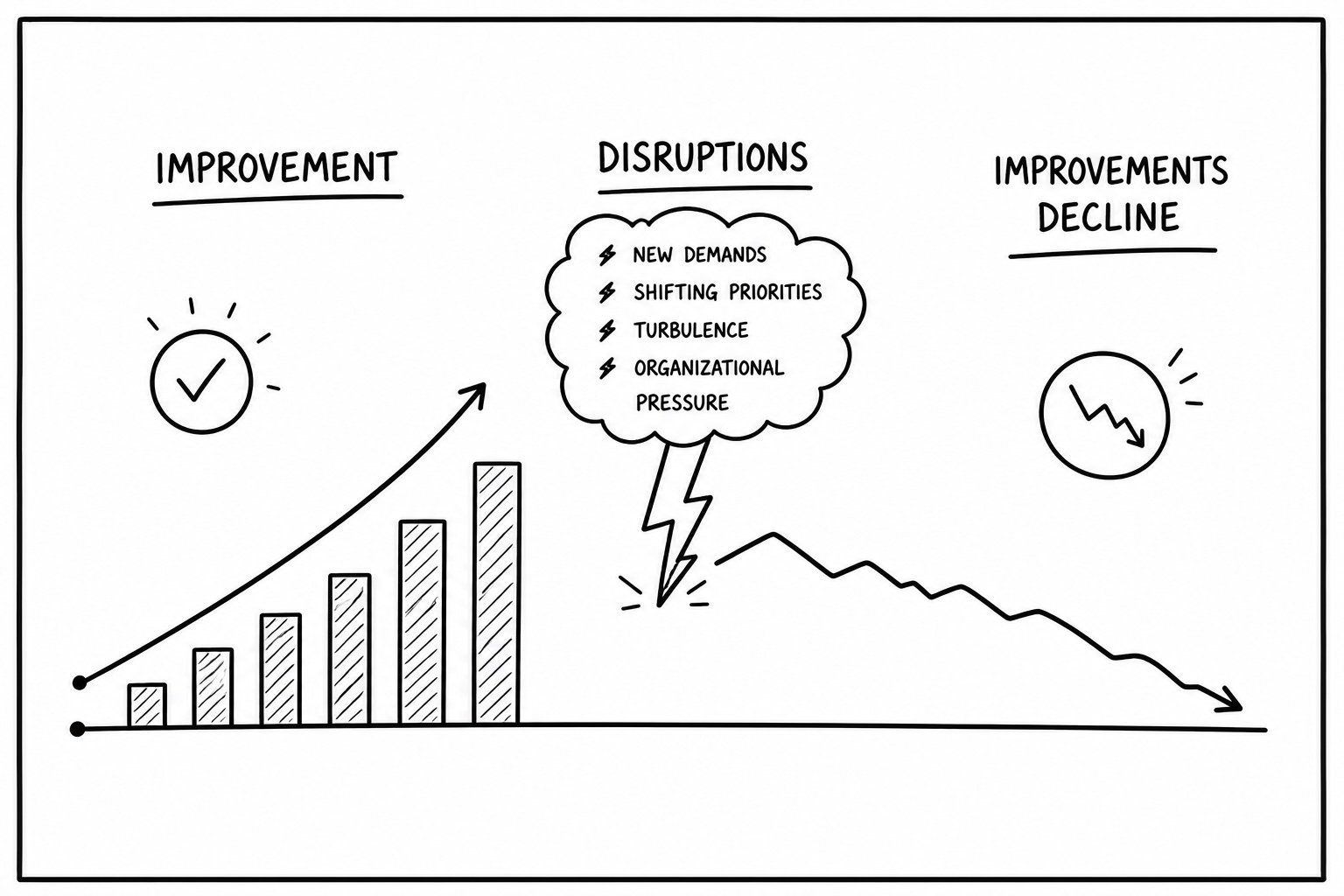
Your lean program is stalling. The floor improvement that took months to build is eroding under organizational pressure. You’re getting consistent direction in the 1:1s, asking the right questions, and looking for where the overburden is concentrated.
And your direct reports are telling you everything is fine.
They are not lying. They are making a rational calculation based on what they have observed in your organization. And until you understand that calculation, the most well-designed 1:1 structure in the world will produce sanitized answers, and the overburden will stay invisible until it shows up as a missed commitment, a degraded delivery, or a resignation that nobody saw coming.
The Muri-Mura-Muda cascade applies here exactly as it does on the floor. Overburden creates variation. Variation creates waste. The difference is that on the floor, the variation is visible. In the leadership system, it stays hidden until the cost has already accumulated, often for months.
The question is not whether the capacity problem will surface. It will. The question is whether you will find out before or after it costs you something significant. That answer depends entirely on one thing: whether the environment was designed to surface it early.
A Case of Bad Environment
Most environments don’t start hostile. They start neutral.
The organization does not announce that problems should be hidden. No policy says vulnerability is punishable. The environment simply never signals that bringing a problem forward is safe. And in the absence of that signal, people default to self-protection.
The direct report who doesn’t mention they’re overloaded isn’t being dishonest. They are making a rational calculation based on what they have observed. What happened the last time someone raised a concern? Was it met with curiosity or interrogation? Did the person who flagged the problem get associated with the problem?
Those observations accumulate over time. Quietly. Without you knowing about it.
When the environment deteriorates further. The silence becomes systemic. When disagreement gets punished. When anyone who doesn’t align with the leadership narrative gets ostracized, the cost compounds at every level. People who can’t afford to lose their jobs hide the overburden. They suffer until it affects their performance. People who care deeply about their work but can’t operate in that environment disengage. And will quietly resign. Over time, the people who leave are the ones you could least afford to lose.
Recovery from that level of systemic failure is difficult and slow.
But most leaders are not there yet. They are in the earlier version. The neutral environment that was never designed to surface problems early. That version is recoverable. The design constraint is simpler than it seems.
The Structural Change that Makes 1:1 Work
I learned about a specific design constraint from a senior operations executive that makes the 1:1 an effective trust-building mechanism and produces honest answers.
This involves you letting your direct report control the agenda for the 1:1. They decide the time, duration, and topics needed to discuss. When the meeting is controlled by you, it serves your information needs. But when the meeting is defined by your direct report, it serves the relationship and provides a path to surface the problems that need attention.
This is the structural change that converts the 1:1 from a reporting mechanism into a maintenance window, the planned pause where Muri is detected before it cascades into the inconsistency and waste your lean program was designed to eliminate.
This is counterintuitive for operations leaders who run structured, agenda-driven environments. But the 1:1 is not a production meeting. It is a trust mechanism. The design requirements are different here.
Embracing Bad News as an Operational Standard
There is a common phrase among teams that follow lean/TPS principles: “embrace the bad news.”
We must embrace the bad news. This is not a value statement, but it should be treated as an operational principle with observable behaviours attached to it.
What happens in the ten seconds after a direct report tells you something went wrong determines whether that person, and everyone watching, will tell you something went wrong again. This is the moment where you build trust or lose it.
If the response is blame, interrogation, or visible frustration, the signal is clear. Next time, the problem gets managed before it reaches you. You get the filtered version. The gap between reality and what you know widens.
Embracing bad news means responding to difficult information with curiosity, not judgment. What happened? What do you need? How do we prevent it? That sequence, consistently, is what makes the 1:1 structure from the previous post actually work.
People Mirror What They See
There is another dynamic that is worth mentioning here.
Your direct reports are always watching how you carry capacity at work. If you are always running at 110% capacity, you are visibly overloaded and always accepting more responsibilities. You are sending a signal that this is acceptable in this organization.
They will not tell you that they are drowning because they see you not doing that either,
The environment for honest capacity conversations starts with the leader. Not with a policy. Not with a values framework. But with what you consistently model in the same 1:1, you are asking them to trust.
A leader running at 110% who asks their team to surface capacity problems honestly is asking them to do something the leader is visibly unwilling to do themselves. The 1:1 structure works. The questions work. The trust mechanism works. But only when the leader has first engineered their own capacity, because the environment for honest capacity conversations is set by what the leader models, not by what the leader asks.
This is why Respect for People starts with yourself. Not as a wellness principle. As an operational prerequisite for the leadership system to function the way your lean program requires.